
Waterless Trap Inserts
Innovative waterless trap inserts that use a floating membrane seal to prevent odors without requiring water. Perfect for water conservation projects and freeze-prone environments.
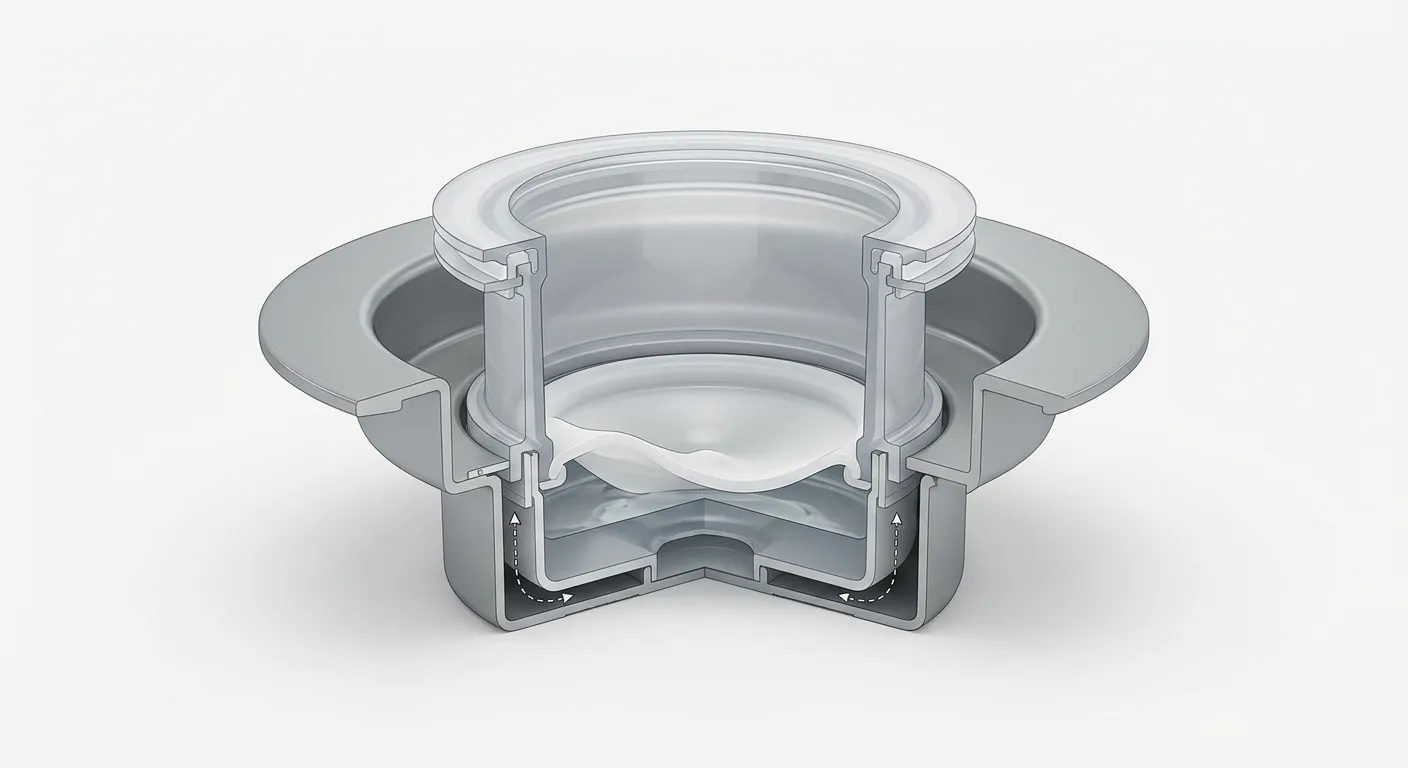
Key Features
- Zero water consumption for odor sealing
- Floating membrane technology
- EAD 180020-like performance standard
- Freeze-resistant (no water to freeze)
- Ultra-low profile design
- Retrofit into existing floor drains
- Chemical-resistant materials
- Maintenance-free operation
Materials & Specifications
Available Materials
Ideal For
Product Details
Technical Specifications
| Standard | EAD 180020-like performance |
| Mechanism | Floating membrane (EPDM/silicone) |
| Seal Type | Airtight (membrane against trap body) |
| Moving Parts | None (membrane only) |
| Durability | 100,000+ open/close cycles (membrane elasticity) |
| Response Time | 1-2 seconds (opens/closes with flow) |
| Flow Rate | 20-35 L/min (depending on size) |
| Sizes Available | Ø100mm, Ø150mm (round); 100x100mm, 150x150mm (square) |
| Temperature Range | -20°C to +80°C (freeze-resistant) |
| Water Consumption | Zero (no water required for seal) |
Installation Guide
Need Freeze-Proof Odor Control?
Our waterless trap inserts provide reliable odor prevention in freeze-prone and water-scarce environments.
Request SamplesRelated Products
Mechanical Odor Traps (EN 1253-7)
EN 1253-7 compliant mechanical odor traps that automatically seal to prevent sewer gases from entering buildings. Ideal for seldom-used floor drains where water seals may dry out.
Learn more →Balcony & Terrace Floor Wastes
Weather-resistant floor drains designed for outdoor balconies, terraces, and patios. Built to withstand UV exposure, temperature variations, and heavy rainfall.
Learn more →Frequently Asked Questions
How does a waterless trap insert work?
Waterless trap inserts use a floating membrane (EPDM rubber or silicone) that operates on simple fluid dynamics. When water flows through the drain, the flow pressure pushes the flexible membrane aside, creating an open passage for water to enter the plumbing system. When water flow stops, the membrane's natural elasticity and gravity cause it to return to its closed position, creating a tight seal against the trap body that prevents sewer gases from entering. The membrane has no mechanical springs, hinges, or moving parts — it is a single flexible element. This simple design means there are virtually no moving parts to wear out, making waterless traps essentially maintenance-free with a service life of 5-10 years before membrane replacement is needed.
What is EAD 180020 and why does it matter?
EAD 180020 (European Assessment Document 180020) is the European performance standard for waterless odour traps used in buildings. It defines comprehensive testing requirements for: (1) **Flow capacity** — ensuring the trap does not significantly restrict water flow; (2) **Odor tightness** — verifying the closed membrane maintains an airtight seal under pressure differentials; (3) **Chemical resistance** — testing membrane durability against sewer gases, cleaning chemicals, and wastewater; (4) **Temperature resistance** — verifying performance from -20°C to +80°C; (5) **Durability** — testing the membrane through repeated open/close cycles. Products meeting EAD 180020-like performance can be specified in projects where traditional water seals are impractical, such as in freeze-prone balconies, water conservation projects, or seldom-used drains where water seals would dry out. We provide test data and performance documentation to support specification submissions.
Can waterless traps be used in freezing environments?
Yes, waterless trap inserts are the ideal solution for freeze-prone environments because they contain no water that could freeze and compromise the seal. Traditional water seals freeze in unheated spaces (balconies, terraces, unheated utility rooms) during winter, allowing sewer gases to enter and potentially causing the trap body to crack as the water expands. Waterless traps maintain their seal regardless of temperature — the EPDM/silicone membrane remains flexible and elastic at temperatures as low as -20°C. This makes waterless traps the recommended solution for balconies, terraces, and outdoor drainage in cold climates where freeze-related odor issues are a common problem.
Do waterless traps require any maintenance?
Waterless trap inserts are essentially maintenance-free due to their simple design with no moving parts. We recommend annual inspection as a best practice: (1) Lift the grate; (2) Visually inspect the membrane for any signs of damage, deformation, or debris accumulation; (3) Clean the membrane with water and a soft brush if debris is present; (4) Verify the membrane returns to its closed position after manually opening it. If the membrane becomes damaged, hardened, or loses elasticity (typically after 5-10 years of service), replace the entire cartridge. Replacement cartridges are available as spare parts with no minimum order quantity. For most residential applications, the waterless trap will outlast the floor drain body without requiring any maintenance.
What is the difference between waterless traps and mechanical traps?
Both waterless and mechanical traps provide odor prevention without relying on a water seal, but they use different mechanisms: (1) **Waterless traps** use a floating membrane with no moving parts. The membrane opens with water flow and closes by gravity/elasticity when flow stops. They are maintenance-free, freeze-resistant, and ideal for water conservation. They meet EAD 180020-like performance standards; (2) **Mechanical traps** use a spring-loaded or gravity-operated flap with moving parts. They are tested for 100,000+ cycles and are recognized by EN 1253-7. They are restricted to buildings up to ~4 storeys. Choose waterless traps for freeze resistance, zero maintenance, and water conservation. Choose mechanical traps for EN 1253-7 code recognition and building code compliance in European markets.
Can waterless traps be retrofitted into existing floor drains?
Yes, our waterless trap inserts are designed for easy retrofit into most standard floor drain bodies. The cartridges are available in standard sizes (Ø100mm, Ø150mm round; 100x100mm, 150x150mm square) that fit the majority of European and international floor drain bodies. For retrofit installation: (1) Remove the existing trap insert from the floor drain; (2) Clean the drain body; (3) Insert the waterless trap cartridge; (4) Test operation by pouring water through the drain. No plumbing modifications are required. If you are unsure about compatibility, send us a photo of your existing floor drain and we will confirm the correct cartridge size.
Request Waterless Trap Inserts (EAD 180020) Samples & Pricing
Get product samples, technical datasheets, and competitive OEM pricing from our team.