
Healthcare & Cleanroom Drainage Solutions
Hygienic drainage solutions for healthcare facilities, hospitals, and cleanroom environments. Minimize contamination risks with our specialized sanitary drain designs.
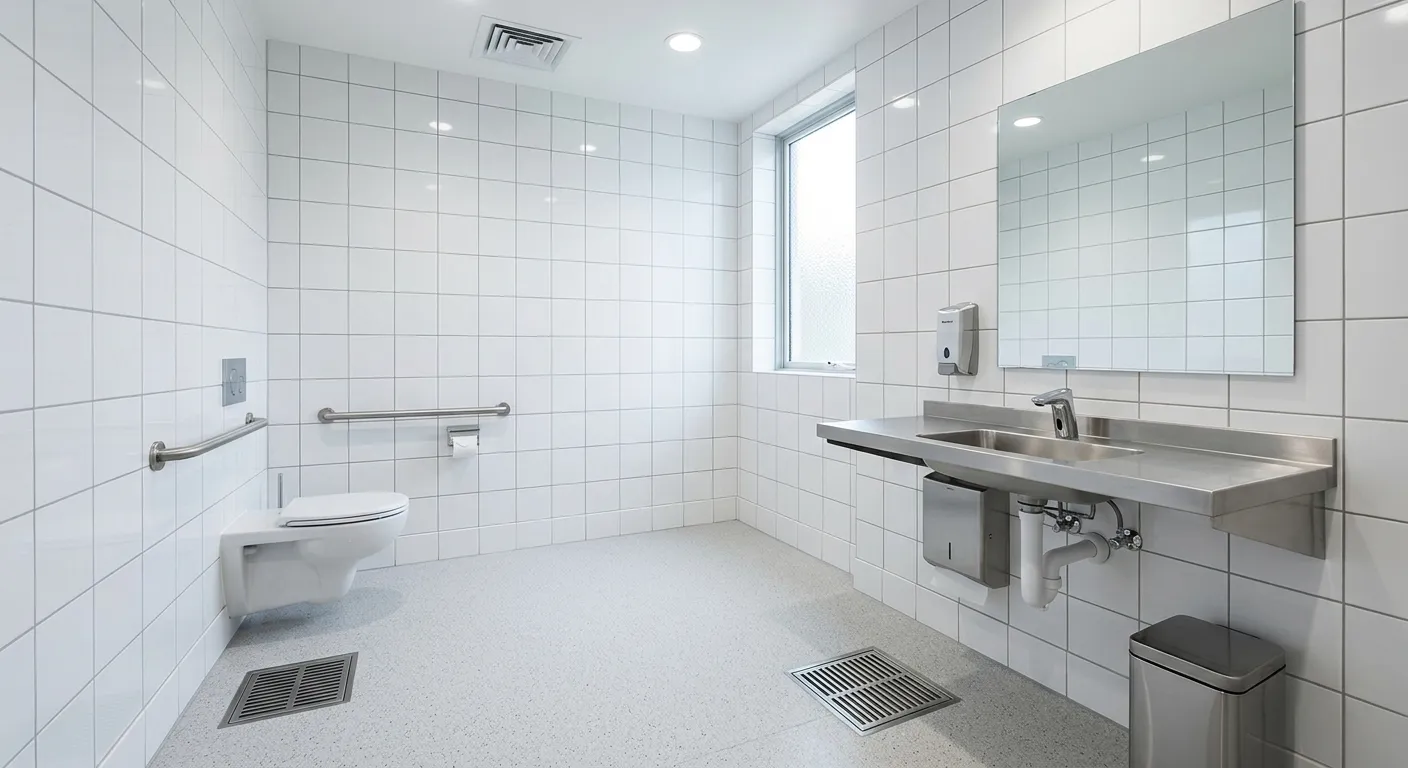
Key Challenges
- Preventing bacterial growth in drain systems
- Meeting strict hygiene standards in healthcare environments
- Ensuring airtight seals to prevent odor and gas transmission
- Handling chemical disinfectants and cleaning agents
- Maintaining drainage during power outages (for critical areas)
Benefits
- 316 stainless steel with smooth, crevice-free internal geometry
- Fully welded seams prevent bacterial harborage points
- Chemical-resistant to hospital-grade disinfectants
- Mechanical odor traps provide airtight sealing
- Easy-clean design supports infection control protocols
Solution Overview
Installation Notes
Specifying Healthcare Drainage?
Our technical team provides infection control documentation, CAD layouts, and compliance support for healthcare projects.
Request Healthcare PackageRecommended Products
Food Processing Hygienic Drains
Sanitary drainage solutions for food and beverage processing facilities. Designed with hygienic principles to prevent contamination and meet FDA/HACCP requirements.
View product →Mechanical Odor Traps (EN 1253-7)
EN 1253-7 compliant mechanical odor traps that automatically seal to prevent sewer gases from entering buildings. Ideal for seldom-used floor drains where water seals may dry out.
View product →Case Study
A hospital construction project in Singapore specified our hygienic drains for surgical suites, laboratories, and patient bathrooms across a 500-bed facility. The smooth internal geometry and chemical-resistant 316 stainless steel construction met the facility's strict infection control requirements and passed all hygiene inspections.
Frequently Asked Questions
What makes a drain suitable for healthcare environments?
Healthcare-grade drains must have: (1) smooth, crevice-free internal surfaces that prevent bacterial biofilm formation, (2) chemical-resistant materials (316 stainless steel) that withstand hospital-grade disinfectants, (3) complete drainage without standing water, (4) airtight odor seals to prevent gas transmission, and (5) easy-clean design that supports daily infection control cleaning protocols. Our hygienic drain line is specifically designed to meet all these requirements.
Can your drains be used in operating rooms and surgical suites?
Yes, our hygienic floor drains are suitable for operating rooms and surgical suites. They feature fully welded 316 stainless steel construction with smooth internal geometry, airtight mechanical odor traps, and chemical resistance to hospital-grade disinfectants. The drains can be specified with flush-mounted grates for seamless floor integration and easy cleaning.
Do you provide technical documentation for healthcare project submissions?
Yes, we provide comprehensive technical documentation for healthcare project submissions including: dimensional drawings, material certifications, flow rate test reports, installation specifications, and compliance documentation. Our technical team can also prepare pre-written specification sections that engineers can incorporate directly into project documents.
What is the recommended maintenance schedule for healthcare drains?
Healthcare drains should be cleaned daily as part of the facility's infection control cleaning protocol. This includes wiping the grate surface, removing the basket, and rinsing the channel. Weekly deep cleaning should include brushing the channel interior and inspecting the odor trap mechanism. Monthly inspections should verify the integrity of the mechanical seal and the condition of the stainless steel surface. All maintenance activities should be documented per facility requirements.
What surface finish is required for healthcare-grade drains?
Healthcare-grade drains must have a smooth internal surface finish of Ra ≤ 0.8μm (roughness average) to prevent bacterial adhesion and biofilm formation. Our hygienic drains achieve this through: (1) **Precision polishing** — all internal surfaces (channel body, trap, outlet) are mechanically polished to Ra ≤ 0.8μm using progressively finer abrasive media; (2) **Electropolishing** (optional) — an electrochemical process that removes surface imperfections and enhances the passive oxide layer, providing superior corrosion resistance and an even smoother surface (Ra ≤ 0.4μm achievable); (3) **Weld quality** — all internal welds are ground smooth and polished to match the surrounding surface finish, eliminating crevices where bacteria could harbor. We provide surface finish test reports (measured with a profilometer) with every healthcare drain order, documenting the Ra value at multiple points on the drain surface. For critical applications such as surgical suites and ISO Class 5+ cleanrooms, we recommend the electropolished option for maximum hygiene performance.
Do you provide validation and commissioning documentation for healthcare facilities?
Yes, we provide comprehensive validation and commissioning documentation packages for healthcare projects, designed to support your facility's qualification process (IQ/OQ/PQ): (1) **Installation Qualification (IQ)** — dimensional drawings, material certificates (EN 10204 Type 3.1), surface finish test reports, and installation specifications verifying the drain is installed per design; (2) **Operational Qualification (OQ)** — flow rate test reports verifying the drain performs within specified parameters, water seal depth verification, and mechanical odor trap function test results; (3) **Performance Qualification (PQ)** — we can provide on-site commissioning support where our technical team performs flow testing, odor seal verification, and visual inspection of all internal surfaces during facility startup; (4) **Maintenance documentation** — cleaning protocols, inspection schedules, and spare parts lists aligned with your facility's maintenance management system. Our healthcare documentation package is designed to meet the requirements of Joint Commission, HTM 04-01 (UK), and similar healthcare facility standards worldwide. Contact our healthcare specifications team for project-specific documentation requirements.
Get Healthcare & Cleanrooms Solutions
Contact our team for product recommendations and project-specific drainage solutions.