
Industrial Floor Gullies
Heavy-duty floor gullies designed for industrial environments with extreme loads and demanding drainage requirements. Built for factories, warehouses, and loading areas.
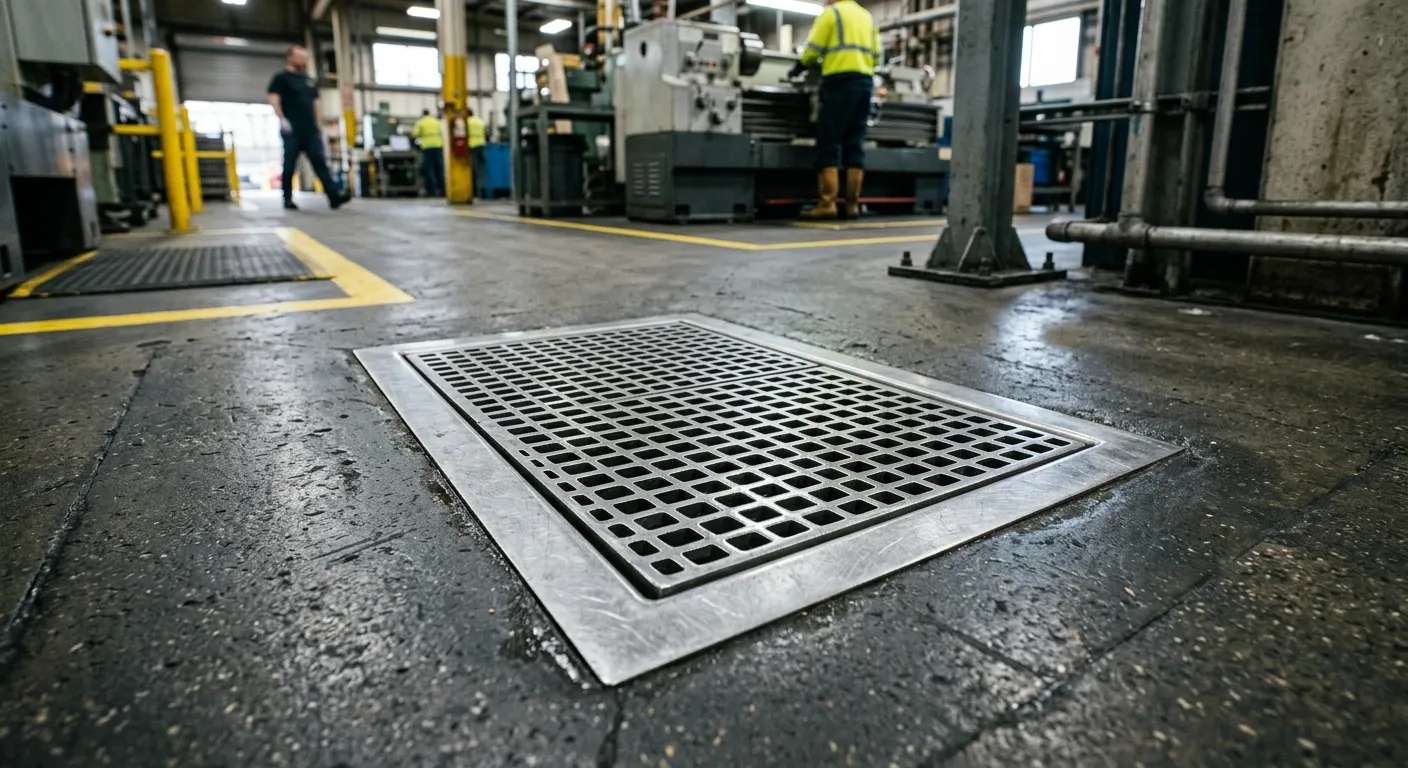
Key Features
- Heavy-duty load ratings (up to Class F/40 tonnes)
- 316 stainless steel construction
- Deep sediment trap for debris collection
- Large inlet area for high-volume drainage
- Reinforced frame for vehicle traffic
- Anti-slip grate surface
- Multiple outlet sizes (75mm-160mm)
- Custom configurations available
Materials & Specifications
Available Materials
Ideal For
Product Details
Technical Specifications
| Flow Rate | 80-120 L/min (depending on outlet size) |
| Outlet Sizes | 75mm, 100mm, 110mm, 160mm |
| Load Classes | K (90t), L (25t), M (12.5t), N (1.5t) |
| Sediment Trap Depth | 150-200mm |
| Material | 316 Stainless Steel |
| Steel Gauge | Body: 2.0-3.0mm, Frame: 3.0-4.0mm, Grate: 4.0-6.0mm |
| Temperature Range | -20°C to +300°C |
| Grate Options | Solid, perforated, slotted, bar grate |
| Compliance | EN 1253, ASME A112.6.3 |
Installation Guide
Need Industrial Drainage Solutions?
Our technical team can provide load calculations, flow capacity data, and custom configurations for your industrial facility.
Request Engineering SupportRelated Products
Commercial Kitchen Trench Drains
Grease-compliant trench drains for commercial kitchens and food service areas. Designed to meet health department standards with proper slope, material selection, and easy cleaning access.
Learn more →Food Processing Hygienic Drains
Sanitary drainage solutions for food and beverage processing facilities. Designed with hygienic principles to prevent contamination and meet FDA/HACCP requirements.
Learn more →Frequently Asked Questions
What load class do your industrial floor gullies support?
Our industrial floor gullies are available in four load classes per EN 1253: (1) **Class K (90 tonnes)** — for heavy industrial areas with forklift traffic, loaded pallet jacks, and heavy equipment. Recommended for manufacturing plants, warehouses, and distribution centers; (2) **Class L (25 tonnes)** — for areas with light forklift traffic and occasional truck access. Suitable for light industrial and commercial applications; (3) **Class M (12.5 tonnes)** — for areas with light vehicular traffic (cars, vans) and heavy pedestrian use. Common in parking garages and loading areas; (4) **Class N (1.5 tonnes)** — for pedestrian-only areas. Suitable for industrial facilities with no vehicular traffic. The load class is determined by the grate thickness, frame construction, and support structure. We recommend Class K for most heavy industrial applications to ensure adequate capacity for unexpected load increases.
What outlet sizes are available for industrial gullies?
We offer industrial floor gullies with four outlet size options: (1) **75mm** — for light industrial applications with moderate flow requirements; (2) **100mm** — the most common size for general industrial drainage, suitable for most washdown and process water applications; (3) **110mm** — for high-flow applications including stormwater management and large-volume washdown; (4) **160mm** — for extreme flow requirements such as flood drainage, emergency spill containment, and large industrial process water discharge. The outlet size should be selected based on the expected flow volume and the size of the building's waste piping system. Our technical team can provide flow calculations to help you select the appropriate outlet size for your specific application.
Can these gullies be used in chemical processing areas?
Yes, our 316 stainless steel industrial gullies are suitable for most chemical processing environments. The 316 grade provides excellent resistance to: (1) Dilute acids (sulfuric, nitric, phosphoric at concentrations up to 10%); (2) Alkalis (sodium hydroxide up to 50% concentration); (3) Solvents (alcohols, ketones, hydrocarbons); (4) Oils and lubricants; (5) Process salts and brines. For highly aggressive chemical environments involving concentrated hydrochloric acid, hydrofluoric acid, or hot concentrated sulfuric acid, please consult our technical team for material compatibility assessment. In these cases, we may recommend specialized coatings, alternative materials, or specific gully configurations to ensure long-term performance.
Do you offer custom-sized industrial floor gullies?
Yes, we manufacture custom-sized industrial floor gullies to meet specific project requirements. Custom options include: (1) Custom dimensions (length, width, depth) to fit specific floor openings or replacement requirements; (2) Custom load ratings beyond standard EN 1253 classes for specialized industrial applications; (3) Custom outlet configurations (multiple outlets, specific orientations, adapted outlet sizes); (4) Custom grate patterns for specific slip resistance or flow requirements; (5) OEM branding with your logo laser-engraved on the gully body and grate. Minimum order quantities for custom gullies are typically 10-20 units depending on the customization level. Lead time for custom orders is 3-5 weeks. Contact our OEM team for detailed pricing and lead time information.
How often should industrial floor gullies be cleaned?
Cleaning frequency depends on the industrial process and debris generation rate: (1) Heavy debris environments (food processing, metalworking, construction): Daily or every-shift cleaning of the sediment trap; (2) Moderate debris environments (general manufacturing, warehouses): Weekly cleaning of the sediment trap; (3) Low debris environments (chemical processing, clean industrial): Bi-weekly or monthly cleaning. In all cases, the grate should be lifted and the sediment trap removed, emptied, and replaced. The gully body should be inspected quarterly for corrosion, weld integrity, and structural condition. Any gullies showing signs of corrosion or structural damage should be replaced immediately to prevent floor collapse under load.
Request Industrial Floor Gullies Samples & Pricing
Get product samples, technical datasheets, and competitive OEM pricing from our team.