
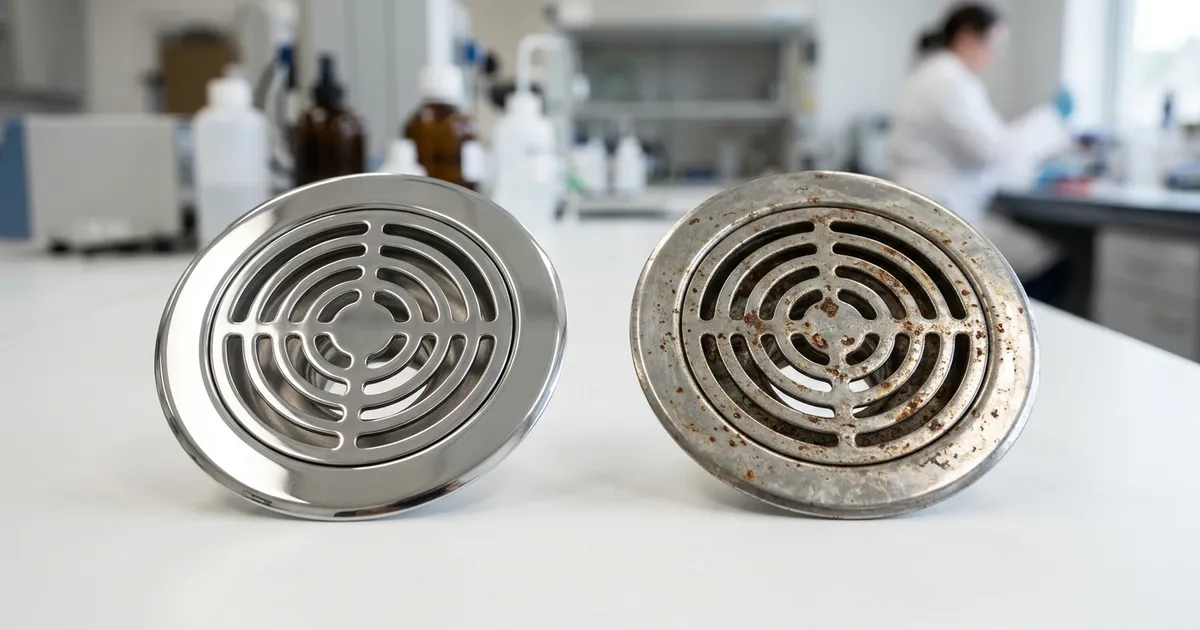
How to Choose 304 vs 316 Stainless Steel for Floor Drains: A Complete Material Selection Guide
Choosing between 304 and 316 stainless steel for floor drains is one of the most important material decisions in building drainage specification. The wrong choice leads to premature corrosion, product failure, and costly replacement. The right choice ensures 15-25+ years of reliable service with minimal maintenance. This guide explains the differences between 304 and 316 stainless steel, when to use each grade, and how to make the correct selection for your specific application.
Understanding Stainless Steel Grades
Stainless steel is an alloy of iron, chromium, and other elements. The chromium content (minimum 10.5%) forms a passive oxide layer on the steel surface that provides corrosion resistance. Different stainless steel grades contain different alloying elements that enhance specific properties.
304 Stainless Steel (AISI 304, EN 1.4301) is the most widely used stainless steel grade. It contains 18% chromium and 8% nickel (often referred to as "18/8 stainless steel"). The chromium provides general corrosion resistance, while the nickel enhances ductility, weldability, and resistance to acidic environments. 304 stainless steel is cost-effective, widely available, and suitable for most indoor applications.
316 Stainless Steel (AISI 316, EN 1.4401) contains the same chromium and nickel content as 304, plus 2-3% molybdenum. The molybdenum is the critical differentiator — it significantly enhances resistance to chloride-induced pitting corrosion, making 316 grade essential for coastal environments, chemical processing, and applications where chlorides are present. 316 grade is approximately 15-25% more expensive than 304 grade, but the additional cost is justified in applications where 304 grade would corrode prematurely.
When 304 Stainless Steel is Sufficient
304 stainless steel is the recommended choice for most standard indoor applications where chloride exposure is minimal:
Standard Residential Bathrooms: Indoor bathroom environments with normal humidity levels and exposure to water, mild detergents, and household cleaning products. 304 grade provides excellent corrosion resistance in these conditions, with a typical service life of 15-25 years. This includes bathroom floor wastes, residential linear shower drains, and laundry floor wastes. Our Residential Series linear shower drains and bathroom floor wastes are manufactured from 304 stainless steel as standard.
Interior Laundry Rooms: Residential laundry rooms with normal washing machine discharge, laundry detergents, and fabric softeners. 304 grade handles the chemical exposure and water contact without issues.
General Commercial Buildings: Office buildings, retail spaces, and commercial facilities where floor drains see normal use with standard cleaning products. 304 grade is adequate for commercial bathroom floor wastes and general drainage.
Indoor Applications with Normal Exposure: Any indoor application where the drain is not exposed to chlorides, aggressive chemicals, or coastal salt air. 304 grade provides the best value for these applications, delivering reliable performance at the lowest cost.
When 316 Stainless Steel is Required
316 stainless steel is essential for applications where chloride exposure, aggressive chemicals, or harsh environmental conditions would cause 304 grade to corrode prematurely:
Coastal and Marine Environments: Properties within 1-2km of the shoreline are exposed to salt spray containing chlorides that attack 304 stainless steel. In our experience, 304 grade balcony drains in coastal locations typically develop surface rust within 2-3 years, while 316 grade maintains its appearance for 10+ years even in direct ocean exposure. The 15-25% price premium for 316 grade is a small investment compared to the cost of replacing corroded drains.
Commercial Kitchens: Commercial kitchen drains are exposed to hot greasy effluent, aggressive cleaning chemicals (caustic soda, acidic descalers, chlorine sanitizers), and salt from food preparation. This uniquely corrosive environment requires 316 grade — 304 grade kitchen drains typically show visible corrosion within 12-24 months of commercial kitchen operation. Many health codes and NSF/ANSI standards specifically require 300-series stainless steel (304 or 316) for food service drainage, with 316 being the preferred grade for commercial kitchens. Our commercial kitchen trench drains are manufactured exclusively from 316 stainless steel for this reason.
Food Processing Facilities: Food processing drains face similar challenges to commercial kitchens, plus additional exposure to food acids (pH 3-4 for tomato-based products), hot water washdown at 85-120°C, and CIP cleaning chemicals. 316 grade provides the chemical and thermal resistance required for these demanding applications.
Healthcare and Cleanroom Environments: Hospital-grade disinfectants (hydrogen peroxide vapor, quaternary ammonium compounds, chlorine-based agents) are more aggressive than standard cleaning products. 316 grade provides the chemical resistance required for healthcare drainage applications.
Swimming Pool Surrounds: Pool areas are exposed to chlorinated water (chlorine is a chloride source) and high humidity. 316 grade is recommended for pool deck drains, shower drains in pool changing rooms, and any drainage in the pool environment.
Chemical Processing Areas: Industrial environments with exposure to acids, alkalis, solvents, and process chemicals require 316 grade for its superior chemical resistance. For highly aggressive chemical environments (concentrated hydrochloric acid, hydrofluoric acid), specialized materials beyond 316 grade may be required.
Outdoor Applications in Harsh Climates: Outdoor drains in environments with de-icing salts (road salt containing chlorides), industrial pollution, or extreme temperature cycling benefit from 316 grade's enhanced corrosion resistance.
The 201 Stainless Steel Economy Option
201 stainless steel is a lower-cost alternative to 304 grade, containing 16-18% chromium but only 3.5-5.5% nickel (replaced with manganese and nitrogen). The reduced nickel content makes 201 grade approximately 15-20% less expensive than 304 grade, but it also reduces corrosion resistance.
201 grade is suitable for: budget residential projects in dry, well-ventilated indoor environments; projects where the drain will be replaced within 5-10 years; applications where cost is the primary consideration and long-term durability is secondary.
201 grade is NOT suitable for: coastal environments, commercial kitchens, healthcare facilities, outdoor applications, or any environment with chloride exposure or high humidity.
For export projects and long-term installations, we always recommend 304 grade as the minimum. The 15-20% cost savings from 201 grade is rarely worth the risk of premature corrosion and replacement.
Material Selection Decision Matrix
| Application | Recommended Grade | Why |
|---|---|---|
| Standard residential bathroom | 304 | Excellent corrosion resistance for normal indoor use |
| Coastal balcony/terrace | 316 | Salt spray resistance |
| Commercial kitchen | 316 | Chemical and chloride resistance |
| Food processing | 316 | Chemical, thermal, and chloride resistance |
| Healthcare/cleanroom | 316 | Disinfectant resistance |
| Swimming pool area | 316 | Chlorinated water resistance |
| Interior laundry room | 304 | Adequate for detergent exposure |
| Budget residential (dry indoor) | 201 or 304 | 201 for cost, 304 for reliability |
| Industrial/chemical processing | 316 | Chemical resistance |
| Outdoor (non-coastal) | 304 or 316 | 304 for temperate, 316 for harsh |
Verification and Quality Assurance
When purchasing stainless steel floor drains, verifying the material grade is essential. Some manufacturers and suppliers mislabel 201 grade as 304 grade, or 304 grade as 316 grade. At Melody Drain, we verify material composition using spectrometer testing on every batch of incoming stainless steel. We provide material certificates with every order, and third-party inspection (SGS, BV) is available upon request.
For export projects, always verify the material requirements specified by local building codes and project specifications. Many building codes specifically require 304 or 316 grade for certain applications, and using an incorrect grade can result in failed inspections and costly replacement.
Contact our technical team for material selection guidance specific to your application, or request material certificates and test reports for our products. Browse our full product range to see which products are available in 304 vs 316 stainless steel.