
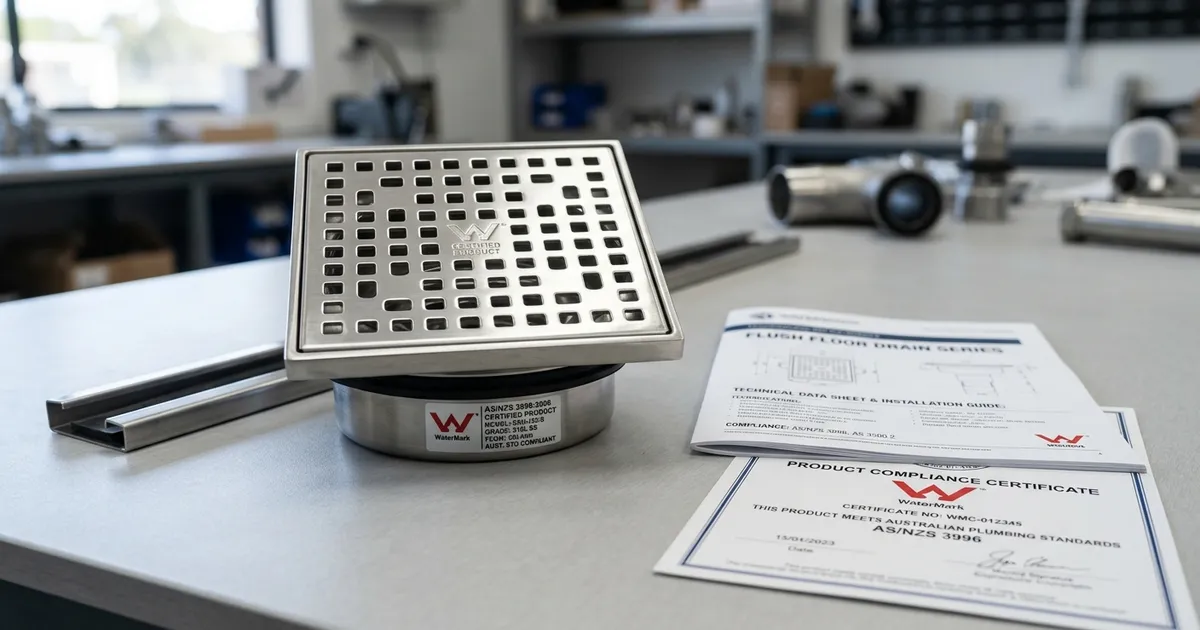
WaterMark Certification: What Australian Importers Need to Know
WaterMark certification is mandatory for all plumbing products sold and installed in Australia, including floor drains, shower wastes, and bathroom drainage fittings. Without WaterMark certification, products cannot be legally installed in Australian buildings, and plumbers who install uncertified products face fines and liability. For importers and distributors, understanding WaterMark requirements is essential before committing to purchasing floor drains from overseas manufacturers. This guide explains the certification process, the standards involved, and what to require from your manufacturing partners.
What Is WaterMark Certification?
WaterMark is a product certification scheme administered by the Australian Building Codes Board (ABCB). It certifies that plumbing and drainage products meet Australian standards and are suitable for use in Australian plumbing systems. The scheme is mandated by state and territory plumbing regulations — every Australian state requires WaterMark certification for specified plumbing products.
There are two levels of WaterMark certification:
Level 1 (High Risk): Products that are critical to health and safety, including pressure-containing fittings, backflow prevention devices, and sanitary plumbing products. Most floor drains and shower wastes fall under Level 1. Certification requires testing by an accredited laboratory and ongoing factory surveillance.
Level 2 (Low Risk): Products with lower health and safety implications. Level 2 certification has less stringent testing requirements but still requires evidence of compliance with the relevant Australian Standard.
Which Australian Standards Apply to Floor Drains?
Floor drains sold in Australia must comply with one or more of the following standards, depending on the product type:
AS/NZS 3688:2013 — Water supply and drainage fittings (plumbing products). This is the overarching standard for plumbing product compliance.
AS/NZS 1892.1:1996 — Floor wastes and shower wastes. Specifies requirements for floor waste gullies, including material thickness, water seal depth, flow capacity, and load rating. This is the primary product standard for residential and commercial floor drains.
AS/NZS 3500.2:2021 — Plumbing and drainage installation (Part 2: Sanitary plumbing and drainage). This installation standard references the product standards and specifies how floor drains must be installed in Australian buildings.
AS/NZS 3665:2012 — Sanitary plumbing products (material requirements). Specifies material standards for brass, copper, stainless steel, and plastic plumbing products.
The Certification Process
Obtaining WaterMark certification involves several steps, and the process typically takes 3-6 months:
Step 1: Product Testing. Submit product samples to a laboratory accredited by JAS-ANZ (Joint Accreditation System Australia New Zealand) or an equivalent international accreditation body recognized by ABCB. Testing verifies the product meets the relevant Australian Standard(s) for: material composition, dimensional accuracy, hydraulic performance (flow rate, water seal), load rating, durability, and corrosion resistance.
Step 2: Application to Certification Body. Submit the test report, product specifications, and application to a WaterMark certification body approved by ABCB. The certification body reviews the test report and verifies compliance with the applicable standard(s).
Step 3: Factory Audit. The certification body conducts an initial factory audit to verify the manufacturing facility has a quality management system capable of producing consistent, compliant products. The audit covers: incoming material inspection, production process control, in-process inspection, final inspection and testing, calibration of test equipment, non-conforming product handling, and traceability systems.
Step 4: Certification and Listing. Upon successful test report review and factory audit, the certification body issues a WaterMark certificate and lists the product on the ABCB's WaterMark product database. The product can then bear the WaterMark logo and be legally sold and installed in Australia.
Step 5: Ongoing Surveillance. WaterMark certification is not a one-time event. Certification bodies conduct annual factory audits and periodic product sampling to verify continued compliance. Manufacturers must maintain their quality management system and notify the certification body of any design or material changes.
What Importers Must Require from Suppliers
When sourcing floor drains from overseas manufacturers (China, India, Southeast Asia, or elsewhere), importers must verify the following before placing orders:
Valid WaterMark Certificate. Request a copy of the WaterMark certificate. Verify the certificate is current (not expired), issued by an ABCB-approved certification body, and covers the exact product model and specification you are purchasing. Some manufacturers hold certificates for one product but ship a different (unlisted) product — always verify the certificate matches the physical product.
ABCB Database Verification. Cross-check the certificate number on the ABCB's WaterMark product database (available at watermarkcertification.com.au). If the product is not listed, the certificate is invalid or the product is not certified.
Test Reports from Accredited Laboratories. Request copies of the test reports that supported the WaterMark application. Verify the laboratory is accredited by JAS-ANZ or an ABCB-recognized equivalent. Test reports should cover all requirements of AS/NZS 1892.1 (or the applicable standard).
Factory Audit Reports. Request the most recent factory audit report from the certification body. This confirms the manufacturer is under active surveillance and the quality management system has been independently verified.
Material Certificates. Require mill certificates for stainless steel, brass, or other materials used in the product. Material certificates verify the chemical composition meets AS/NZS 3665 requirements.
Common Pitfalls for Australian Importers
Assuming EN 1253 Compliance Equals WaterMark Compliance. European EN 1253 standards and Australian AS/NZS 1892 standards have different requirements. A product certified to EN 1253 may not automatically comply with AS/NZS 1892. Additional testing against the Australian standard is typically required.
Accepting "Pending" Certification. Some manufacturers claim certification is "in process" or "pending." Until the certificate is issued and the product is listed on the ABCB database, the product cannot be legally sold or installed. Do not accept pending certification as a substitute for actual certification.
Ignoring Scope Limitations. WaterMark certificates specify the scope — which products, sizes, and configurations are covered. A certificate for a 100mm floor waste does not cover a 150mm floor waste, even if they look similar. Each product variant needs its own certification or explicit inclusion in the certificate scope.
Changing Materials Without Re-Certification. If the manufacturer changes the material (e.g., switches from 316 to 304 stainless steel, or changes the brass alloy), the WaterMark certification may be invalidated. Material changes require notification to the certification body and potentially additional testing.
Overlooking Ongoing Compliance. Even after certification, the manufacturer must maintain compliance. If a factory audit finds non-conformities, the certificate can be suspended or revoked. Importers should periodically verify the manufacturer's certification status remains active.
How to Work with Certified Manufacturers
Working with a manufacturer who already holds WaterMark certification for their products dramatically simplifies the import process. The manufacturer has already completed testing, factory audit, and certification — you are importing a product that is already listed and compliant.
When evaluating suppliers, ask: Which of your products hold WaterMark certification? Can you provide the certificate numbers and ABCB database listings? Are your certificates current and under active surveillance? What is your process for notifying customers of certification changes?
At Melody Drain, we maintain WaterMark certification for our core range of floor wastes, shower wastes, and bathroom drains. Our factory is regularly audited by accredited certification bodies, and we provide certificate documentation and ABCB database verification support to our Australian importers. Contact our team for WaterMark-certified product options for the Australian market.