

Trench & Channel Drains for Driveways, Patios and Decks: The Complete Buyer's Guide
A driveway that puddles at the garage door, a patio that holds a sheet of water after every storm, a deck that rots its frame from standing rain — all three are the same problem with the same family of solutions: a trench drain (also called a channel drain) that intercepts surface water along a line instead of hoping it finds a point drain.
This guide covers what actually goes into specifying one for driveways, patios, decks and commercial yards: terminology, sizing, materials, grates, modular fittings, slope and installation. Dimensions are given in millimeters and inches.
Trench Drain vs Channel Drain: Which Word Is Right?
Both terms describe a linear drain: a channel body set below the surface, covered by a grate, with one or more outlets into the underground drainage. The industry uses them almost interchangeably, with a loose split:
- Trench drain — the full below-grade assembly, usually in polymer concrete, HDPE or cast iron, set into an excavated trench. Common in driveways, forecourts and industrial yards.
- Channel drain — often used for the surface channel section itself, and for lighter systems in stainless or plastic. Common on patios, balconies, pool decks and commercial kitchens.
When you order, the label matters far less than the numbers: internal width, depth, outlet position, grate type, material grade and whether the run is modular. A "channel drain" sized and grated for vehicles is the same product as a "trench drain" — and a pretty decorative one is not.
Where Linear Drains Earn Their Keep
Driveways. The classic position is a run across the top of the slope at the garage door, catching roof runoff and street water before it walks into the garage. A second use is the perimeter of a sloped driveway where water sheets off the apron.
Patios and terraces. A channel along the house line under a door threshold keeps a slab of rain from reaching the wall and the door sill. On paved patios, the drain line doubles as the edge of the slope break.
Decks and balconies. Here the stakes are structural: standing water on a timber deck feeds rot, and on a balcony it migrates into the slab edge. A shallow stainless channel at the door line, tied to the waterproofing layer, is the standard fix. Our linear shower drains share the same stainless construction logic for indoor wet rooms.
Commercial kitchens and food areas. Grease, washdown water and cleaning codes push commercial kitchens toward stainless trench systems with cleanable channels and lift-out grates — see our commercial kitchen trench drains.
Materials: What the Channel Body Is Made Of
| Material | Where it fits | Notes |
|---|---|---|
| Polymer concrete | Driveways, forecourts, industrial | Heavy, very rigid, cheap per meter; needs care when cutting on site |
| HDPE / plastic | Landscaping, light patios | Light and cheap; flexes under point loads, needs concrete encasement |
| Stainless steel (prefabricated) | Patios, decks, balconies, kitchens, light-vehicle yards | Corrosion-resistant, hygienic, slim profile, modular fittings; our standard line |
| Cast iron / galvanized steel | Legacy industrial, road-adjacent | Very strong, but galvanized finishes rust at cut edges and cast iron is heavy to handle |
A prefabricated stainless channel — the type we manufacture — is a formed U-body with bolt flanges at each end, supplied with a slotted or perforated cover. Stainless (304 as standard, 201 for cost-sensitive projects, 316 for coastal salt exposure) is the default wherever the drain is visible, food-adjacent, or thin enough that polymer concrete bulk would not fit. Our guide to 304 vs 316 stainless steel covers grade selection in detail.
Standard Sizes: The Dimension Table That Decides Everything
The three numbers that size a channel are total width, cover width and height (depth). Our prefabricated stainless channel line stocks:
| Size (L × total width × height) | Cover | Approx. inches (L × W × H) |
|---|---|---|
| 580 × 150 × 150 mm | 1 cover | 22.8" × 6" × 6" |
| 580 × 200 × 150 mm | 1 cover | 22.8" × 8" × 6" |
| 580 × 250 × 150 mm | 1 cover | 22.8" × 10" × 6" |
| 580 × 300 × 160 mm | 1 cover | 22.8" × 12" × 6.3" |
| 580 × 350 × 160 mm | 1 cover | 22.8" × 14" × 6.3" |
| 1160 × 150 × 150 mm | 2 covers | 45.7" × 6" × 6" |
| 1160 × 200 × 150 mm | 2 covers | 45.7" × 8" × 6" |
| 1160 × 250 × 150 mm | 2 covers | 45.7" × 10" × 6" |
| 1160 × 300 × 160 mm | 2 covers | 45.7" × 12" × 6.3" |
| 1160 × 350 × 160 mm | 2 covers | 45.7" × 14" × 6.3" |
Two practical readings of this table:
- Width is capacity, height is plumbing. A 150 mm-wide channel on a patio handles rain sheets fine; a 300-350 mm channel is what you want where a downspout discharges into the run or where the driveway apron drains a large catchment. Depth (150-160 mm) must clear your outlet pipe invert — measure the drainpipe before choosing, not after.
- 1160 mm sections are two 580 mm modules joined. The 580/1160 rhythm exists to make corners, branches and job-site cuts easy — see fittings below. Non-standard lengths and sizes are made to order.
Modular Fittings: Corners and Branches Without Welding
The difference between a system and a pile of gutters is the fittings. A proper modular line ships:
- Straight sections — the channel body itself, bolt-flanged at both ends
- 90° elbow — turns a run around a corner
- Tee — branches one run into two (or collects two into one)
- Cross — four-way junction for complex yard layouts
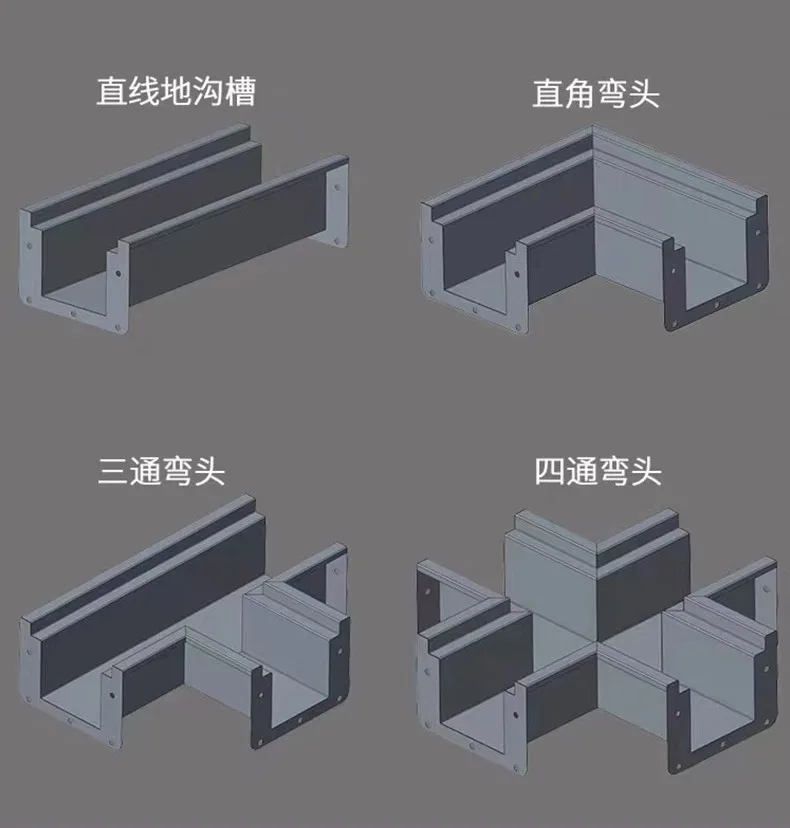
All joints bolt together with the end flanges and seal at the factory-jointed profile. That matters because site-cut and site-sealed channel joints are the first place a trench leaks; a molded fitting leaks nowhere, and a wrong layout can be unbolted and rebuilt instead of demolished. Plan the run on paper with these four pieces — most driveway and patio layouts are a straight run plus one or two elbows, and a tee at the garage entry.
Grates: The Part Everything Rests On (Literally)
The grate decides whether the drain survives your traffic. Match it to what rolls and walks over it:
- Perforated stainless (as supplied with our standard channel) — patios, balconies, pool decks, commercial floors: fast water entry, clean look, pedestrian loads.
- Slotted grates — fewer holes, more solid bearing area; the better default where two-wheel carts or frequent foot traffic run along the line.
- Heavy-duty steel or composite grates — where vehicles cross. If the site is in a market that specifies to EN 1253 (the European standard for surface water drains), classes are assigned by test load — but read the class as a testing framework, not a tonnage promise: a test load is not an allowable wheel load for your slab design, and the surrounding concrete and seating do much of the work.
Whatever the class, fix the grate against lifting on vehicle runs. A loose grate on a driveway is a cracked grate, a damaged tire, and a liability.
Slope: The Two Angles Nobody Checks
A trench drain only works if water is told where to go — twice:
- Surface fall. The finished slab or pavers should slope toward the channel at roughly 2% (about 1/4 inch per foot). Codes for shower floors in the IRC use the same order of magnitude (2-4%); for outdoor slabs, 2% is the practical default. Flatter and you get sheets of standing water; steeper and you get erosion channels and a slab that feels wrong underfoot.
- Channel fall. The run itself needs 0.5-1% along its length toward the outlet so water entering mid-run actually leaves it. Our prefabricated bodies are supplied slope-ready so the fall is built into the channel, not improvised on site. When you draw a reference detail, keep the distinction straight: a 0.5% value belongs to the channel's internal fall layer, not the finished surface slope.
The single most common trench failure is a perfectly installed drain in a perfectly flat patio: the channel sits there, dry, while a millimeter of water covers the slab around it.
Installation Sequence (What a Good Job Looks Like)
- Excavate the run to channel depth plus a compacted base and surround of concrete.
- Set the outlet first. Connect the channel outlet to the drainage pipe (or catch basin) before backfill locks geometry in. Confirm the pipe itself falls away from the drain.
- Lay the line — straight sections, elbows and tees bolted end to end, checking fall along the run with a level or laser at each joint.
- Concrete surround. Channel bodies carry load through the encasement, not the grate alone. A properly haunched concrete collar is what lets a driveway drain survive a car.
- Waterproof the tie-in at doors and slab edges — on balconies and decks the drain flange must land inside the membrane system, not under it. Our CAD details library shows the membrane-flange principle used at drain-to-slab junctions.
- Finish the surface at 2% toward the channel, then seat and fix the grates.
For flow checks on longer runs — how many downspouts or how much roof area one outlet can take — the calculation method is in our flow rate and slope guide.
Five Buyer Mistakes We See Repeatedly
- Buying width for looks, not catchment. Measure the area draining into the run first.
- No outlet plan. A channel with nowhere to discharge is a linear puddle.
- Decorative grate on a vehicle run. Match the grate to the traffic, fix it down.
- Site-cut joints instead of molded fittings. Every cut joint is a future leak; elbows and tees exist for a reason.
- Flat surface, "because the drain is there." The drain intercepts water that reaches it. Slope does the reaching.
Melody Drain
We manufacture prefabricated stainless steel channel drains in 580/1160 mm modular lengths, 150-350 mm widths and 150/160 mm depths, with slotted and perforated covers, bolt-on end caps, and 90° elbow, tee and cross fittings — in 201/304 stainless as standard, 316 on request, with custom sizes made to order. The same channel logic scales from a balcony to a restaurant yard; see the commercial & industrial drain range and our OEM/ODM service for branded and mixed-configuration orders.
Send us the run length, width, outlet position and traffic type — or send the site drawing and we will lay out the modules and fittings for your review. Contact us or message on WhatsApp.