
Channel Drain for Driveway: Sizing, Grate Load Class and Outlets
Water crossing a driveway is not one problem — it is three: rain sheets off the garage roof, runoff travels down the pavement slope, and mud and grit ride in on tires. A channel drain (also called a trench drain) catches all three at the line where they do the most damage. This guide covers the three decisions that make or break a driveway drain installation: sizing the channel, choosing a grate that survives vehicles, and getting the outlet right the first time.
If you want the full picture first — terminology, materials, modular fittings and installation sequence — start with our trench & channel drain buyer's guide. This article goes deep on the driveway case specifically.
Where the Channel Goes: Three Positions That Work
Most driveway drainage failures are position failures before they are product failures. The three placements that earn their cost:
- Across the garage door line. The classic. Catches roof runoff and street water before either walks under the garage door. One run, one outlet, most residential problems solved.
- At the low end of the pavement slope. Wherever water naturally concentrates before leaving the driveway — usually at the street apron — a channel intercepts it before it pools on the road edge or erodes the shoulder.
- Perimeter of an attached patio or walkway. Driveway water that runs along a slab edge migrates toward the house line; a channel at the junction breaks the path.
The positioning rule: a channel only drains water that reaches it. The pavement on both sides must fall toward the channel at roughly 2% (about 1/4 inch per foot). A perfectly sized drain in a flat driveway is a decorative object.
Sizing the Channel: Width, Depth, Length
Width — match the catchment, not the look. For a typical residential driveway, a channel (sometimes sold as a strip drain) with an internal width of 100-200 mm (4"-8") handles rain and roof discharge comfortably. Our fabricated stainless channel line covers 150 / 200 / 250 / 300 / 350 mm widths — go to 250 mm and up when the run must take a downspout's full discharge, a long apron's sheet flow, or a sloped driveway that funnels a large yard. Width is the cheapest capacity to buy at purchase time and the most expensive to add later — excavating a second channel costs multiples of upsizing the first.
Depth — decided by your outlet pipe. Channel body depth (typically 150-160 mm in our standard sections) must clear the invert of the drainage pipe it discharges into, with room for the run gradient. Measure the existing or planned pipe drop before ordering, not after.
Length — bought in modules. Stainless channel systems are fabricated in standard 580 mm and 1160 mm sections bolted end to end, with 90° elbow, tee and cross fittings for corners and branches. A 6 m driveway entry is not a special order — it is a fitting list. Custom lengths are made to order.
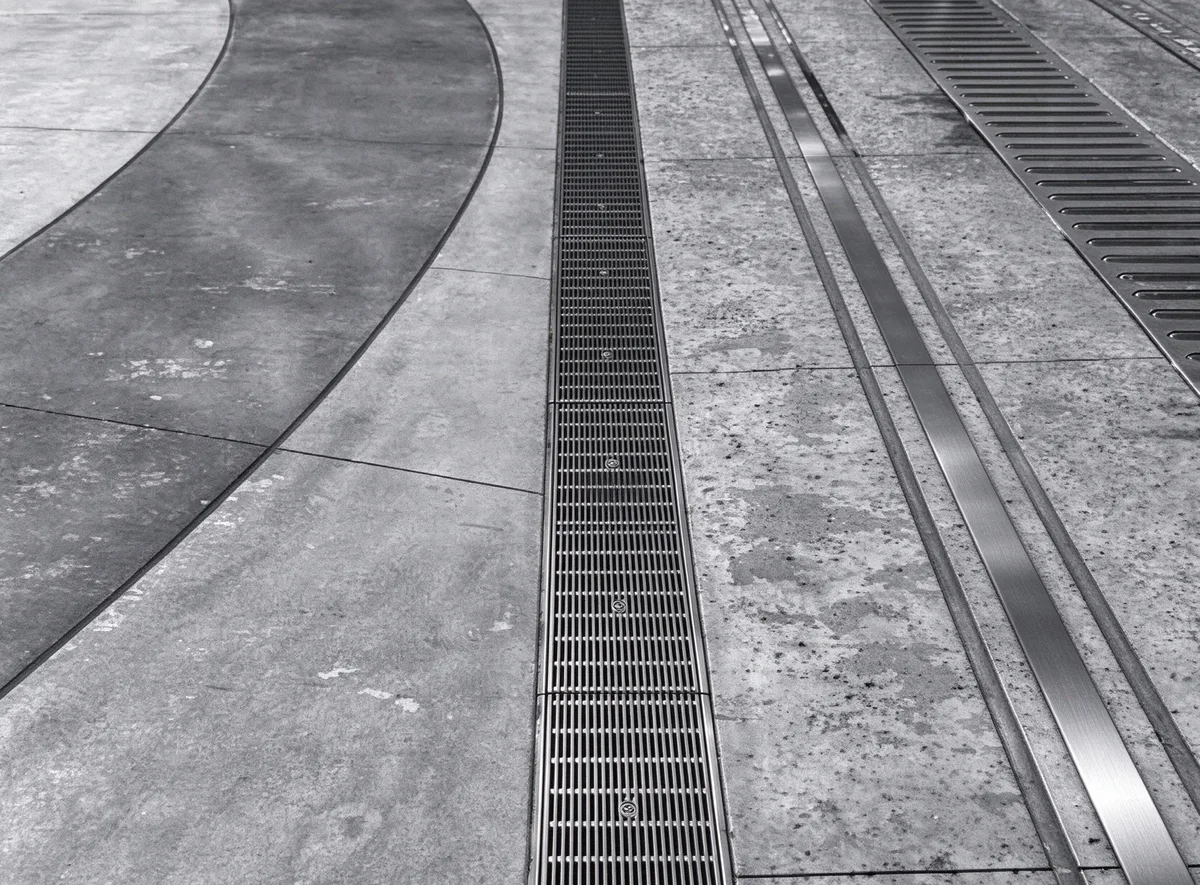
Beyond the straight line — custom geometry. Driveways rarely cooperate with catalog shapes. Besides standard straight runs, we fabricate right-angle, corner and curved (arc) channel bodies to follow the actual terrain: a radius entry that sweeps with the apron, an L-shaped line that hugs two walls, a crescent around a round planter. Curved sections keep the same grate system as straight ones, so the visual line stays continuous. If your layout has a bend that fittings alone cannot resolve cleanly, send the drawing — a fabricated curved body is a normal custom order, not an engineering exception.
The Grate: The Part Vehicles Actually Touch
The channel body sits in concrete; the grate is what your tires, cart wheels and shoes ride over. Three grate families cover driveway duty:
- Perforated stainless plate (round or square holes) — clean look, fast water entry, right for pedestrian-first driveways with occasional car crossing.
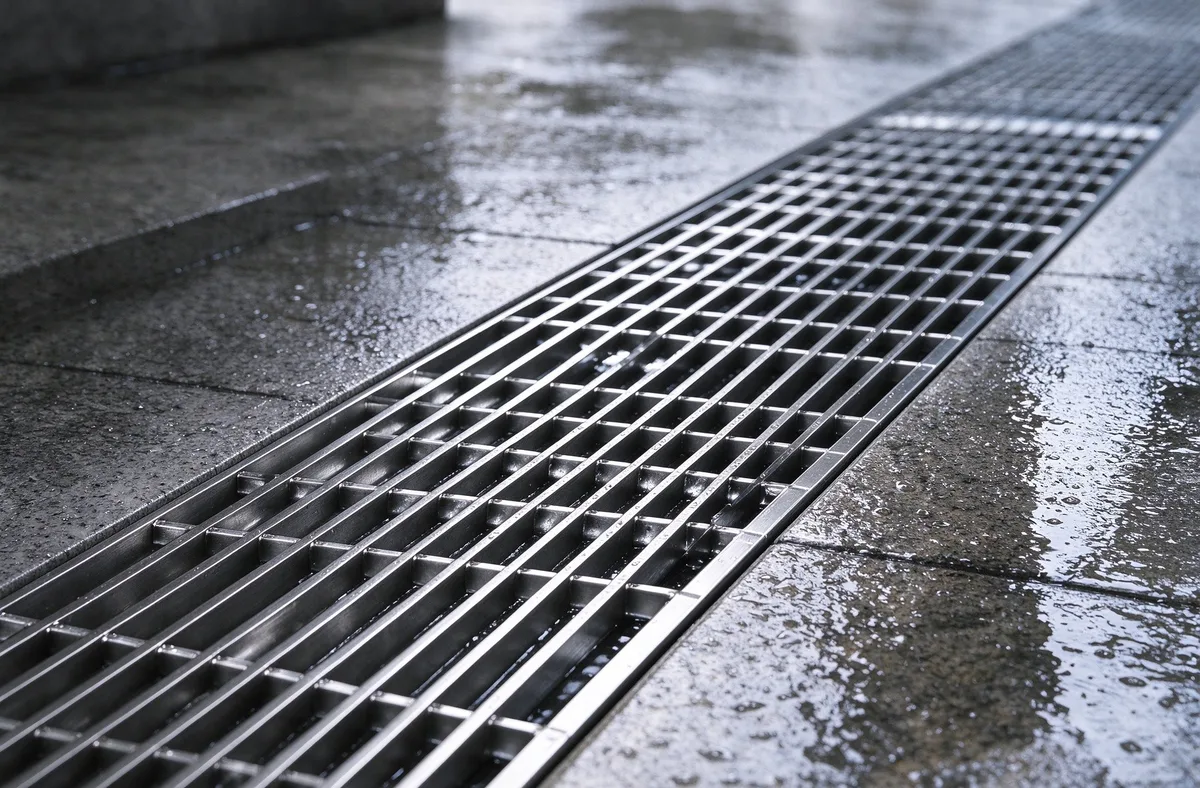
- Grid / bar grating (welded steel or stainless bars) — the workhorse for vehicle areas. Solid bearing bars spread wheel loads while the open area still passes heavy rain. Serrated bar tops add slip resistance when wet.
- Slot grate with frame — narrow slots (typically 3-10 mm open width in fabricated covers) keep leaves and gravel out; the standard choice under trees.
Two specification details separate a serious grate from a cheap one:
- Opening size is a safety spec. Gaps wider than roughly 10 mm catch heels, cart caster wheels and pet legs. Fabricated covers come in the 0.5-10 mm opening range precisely for this — specify the opening; do not accept "whatever the die makes."
- Plate thickness is a duty spec. Pressed stainless covers are made in thickness grades from about 0.3 mm (decorative, pedestrian) through 1.5-2.0 mm (light vehicular); welded bar grating goes heavier again. The right grade depends on what rolls over it and how often — a family car at the garage door line is not a delivery truck at a warehouse apron.
Load Class, Honestly
Driveway drainage content loves throwing tonnage around — "holds 30 tons!" — and most of those numbers are fiction. Here is how load actually works:
- Test load is not permitted load. Standards such as EN 1253 classify drain bodies and grates by an applied laboratory test load. What your installation can safely carry depends on the grate material and thickness, the frame, the concrete encasement and support conditions — the surrounding slab does much of the work. A grate that passes a test load loose on a weak base will still fail.
- Match the class to the real traffic. Pedestrian and garden-cart duty, family-car crossing, or regular delivery-vehicle traffic are three different specification conversations. Name your actual traffic case to the supplier and ask for the configuration — grate thickness, frame, encasement detail — that suits it.
- Fix it against lifting. On vehicle runs, bolted or clipped grate fixing is not optional. A loose grate under a tire edge is a bent grate, a damaged rim, and a claim.
We publish no generic tonnage tables for exactly this reason: send us the traffic case and we will specify against it, model by model, with the test documentation that actually exists.
Outlets: The 30 Minutes That Decide Everything
A channel with the wrong outlet plan is a linear puddle. Three rules:
- One outlet per 6-10 m of run, at the low end. Long runs with a single far outlet spend their capacity fighting friction along the channel. Two short runs with two outlets drain faster than one long run.
- Outlet size at least matches the pipe it lands in. Common residential drops are 75-110 mm (3"-4"). Specify the outlet position and orientation that matches your pipe routing before fabrication — cutting a stainless body on site voids the case for buying fabricated sections at all.
- Discharge goes somewhere legal. The outlet connects to a storm line, a dry well, or a swale — in that order of preference, subject to local rules. Never discharge a driveway channel to a sanitary line without checking code, and never let it daylight at a neighbor's foundation.
Slope Inside the Channel
Surface slope brings water to the grate; the channel run itself also needs fall along its length toward the outlet — 0.5-1% is the practical range. In real installation that fall is set on site to the actual levels: mark the outlet invert first, then lay each bolted section to the string line so the gradient matches the ground, the pipe drop and the driveway's real geometry. Setting the fall during installation is simpler and more reliable than assuming a preset factory gradient, because the site — not the catalog — decides the final levels. Confirm your outlet position and pipe invert with the supplier before fabrication so the sections arrive ready to lay to your line.
Maintenance: Thirty Seconds a Week
Swept leaves and grit are the driveway channel's only real enemy. Lift the grate sections at the end of autumn, clear the channel to the outlet, and run a hose to confirm the drop is clear. Perforated and grid grates lift by hand; a removable basket at the outlet catches the rest before it enters the pipe. That is the entire maintenance program.
Melody Drain
We fabricate stainless steel channel drains in 580/1160 mm modular sections, 150-350 mm widths and 150/160 mm depths, with perforated and grid grating in 304 stainless as standard (201/316 on request), bolt-on elbow/tee/cross fittings, and custom geometry — right-angle, corner and arc-curved bodies for layouts a straight run cannot follow. Send us the driveway length, the traffic case and a photo of the site — we will lay out the run, the grate grade and the outlet drop for your review. See the trench & channel drain range and the buyer's guide, or contact us / message on WhatsApp.