
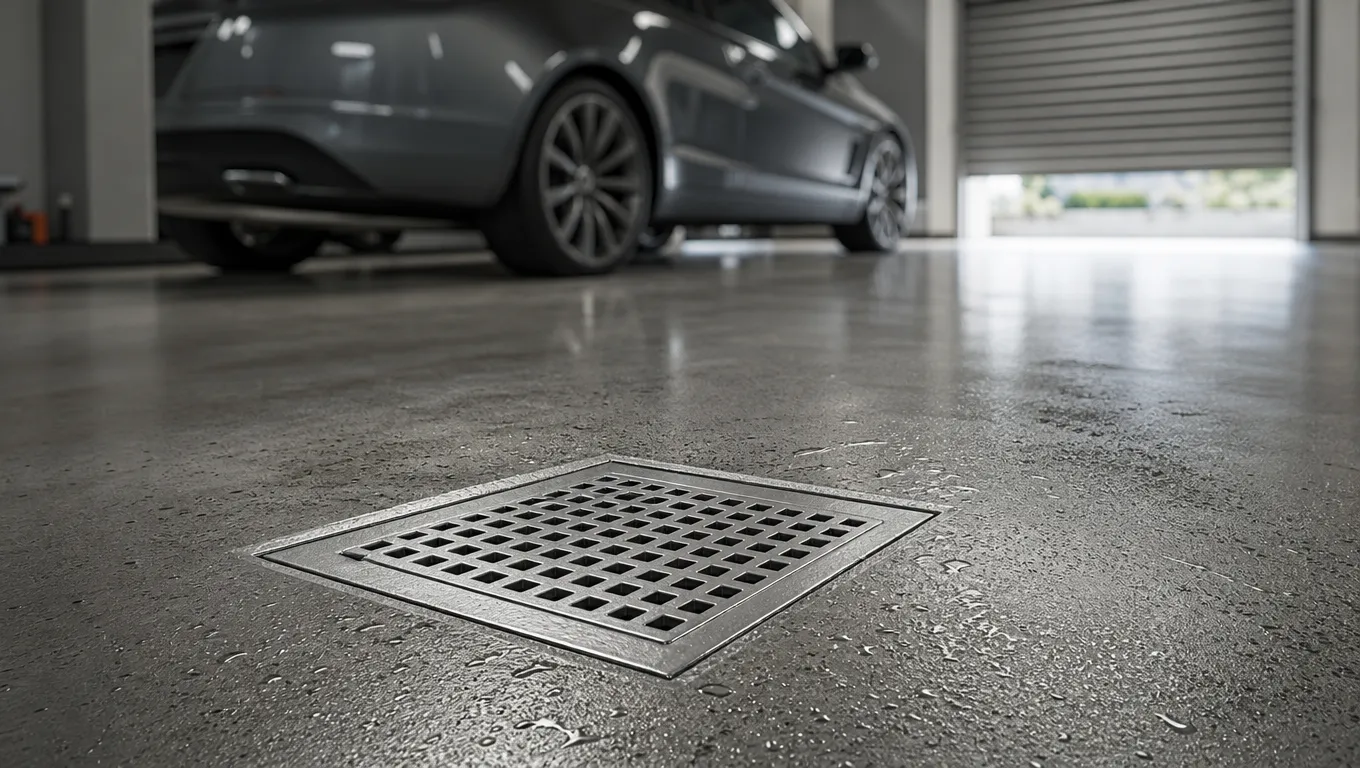
Garage and Basement Floor Drains: Slope, Trap and Freeze Protection
A garage floor drain and a basement floor drain sit in the same house, often tie into the same plumbing, and fail in completely different ways. A garage drain sees meltwater, road grit, de-icing salt, vehicle tires and sub-zero air every time the door opens. A basement drain sits in a warm, dry slab next to a water heater or laundry tub, goes untouched for months until its water seal evaporates, and is the first opening in the house to show a main-line sewer backup.
Part of our floor drain types, parts and applications guide.
This guide covers how to choose and specify floor drains for both spaces: point gullies versus channel drains, slab slope and placement, keeping traps sealed against sewer gas, freeze and road-salt protection, and what actually causes a basement floor drain to back up.
Garage vs Basement: Different Jobs, Different Risks
Treating both slabs the same is how builders end up with cracked plastic grates under car jacks in the garage and dried-out, smelly traps in the basement. Compare the operating conditions before picking hardware:
| Factor | Garage floor drain | Basement / utility floor drain |
|---|---|---|
| Water source | Rain, snowmelt off vehicles, floor washdown | Water heater relief/pan, boiler condensate, laundry overflow, occasional mop-down |
| Debris load | Heavy — sand, gravel, leaves, mud, oil drips | Light — lint, dust, scale |
| Surface load | Tires, floor jacks, tool carts, foot traffic | Foot traffic, appliances, hand trucks |
| Temperature | Unheated or semi-heated; freeze risk near doors | Heated or conditioned; dry winter air speeds trap evaporation |
| Corrosion exposure | High where road salt / chlorides drip off cars | Mild (detergents, bleach in laundry zones, condensate) |
| Typical drain choice | Heavy-duty point gully or threshold trench channel | Deep-seal gully or laundry/utility point drain + backup odor core |
Choosing the Drain Type: Point Gully vs Trench Channel
Three configurations cover almost every residential garage, commercial parking bay, basement and plant room:
1. Serviceable deep-body gully (point drain)
A square or round heavy-duty drain set at the low point of a 4-way sloped slab. Unlike a shallow bathroom waste, a garage or basement gully uses a deep sump body with a lift-out strainer basket and a removable water seal. Grit and gravel settle in the sump below the outlet line instead of washing into the underground pipe and silting it shut.
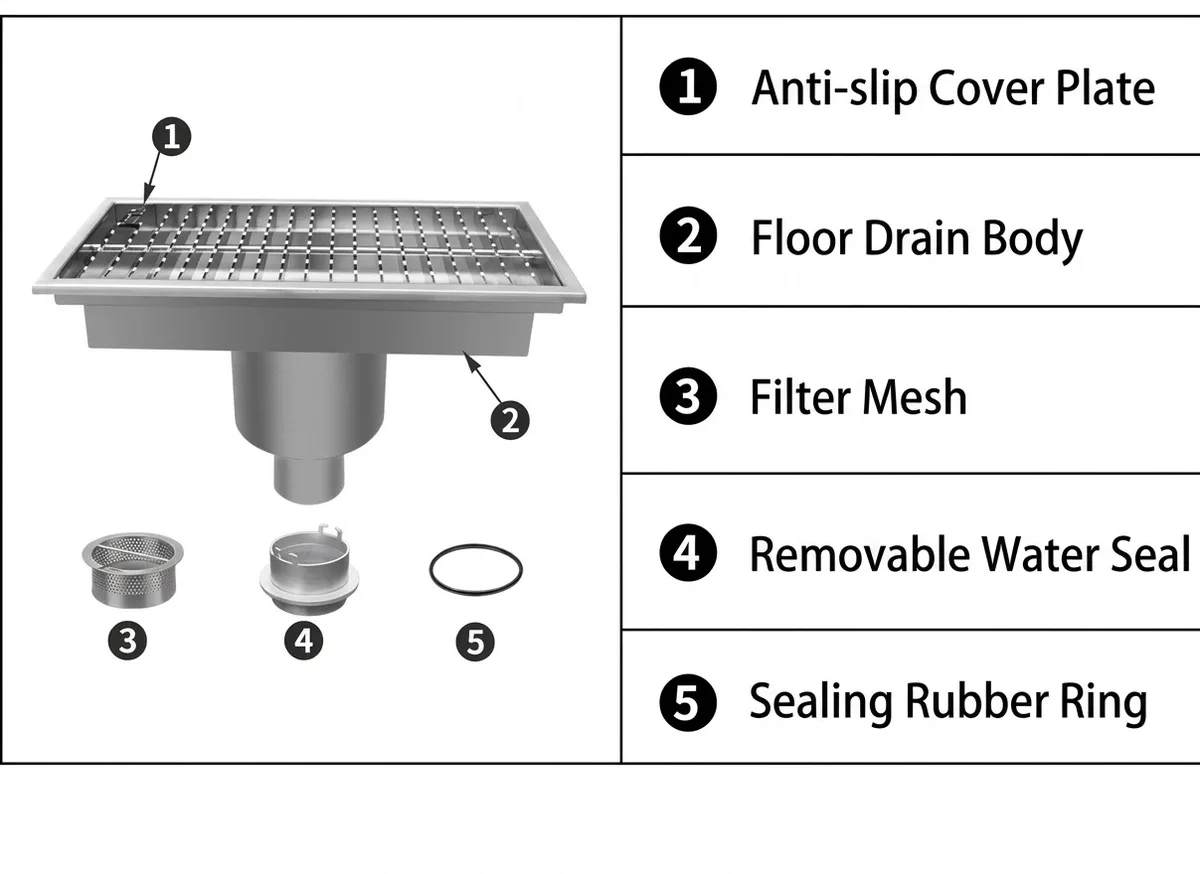
Our industrial floor gullies use a five-part stainless design — anti-slip grid cover, deep sump body, perforated mesh basket, removable water seal and rubber sealing ring — so every wear part lifts out from above without breaking concrete.
2. Trench / channel drain (linear run)
A modular stainless channel set in a straight line — across the garage door threshold, down the center between parking bays, or along a basement walkout door. Because the slab slopes in one flat plane toward the channel instead of four compound triangles toward a center pit, a channel drain is easier to screed cleanly on wide bays and catches sheet water right at the door line before it wets storage along the walls.
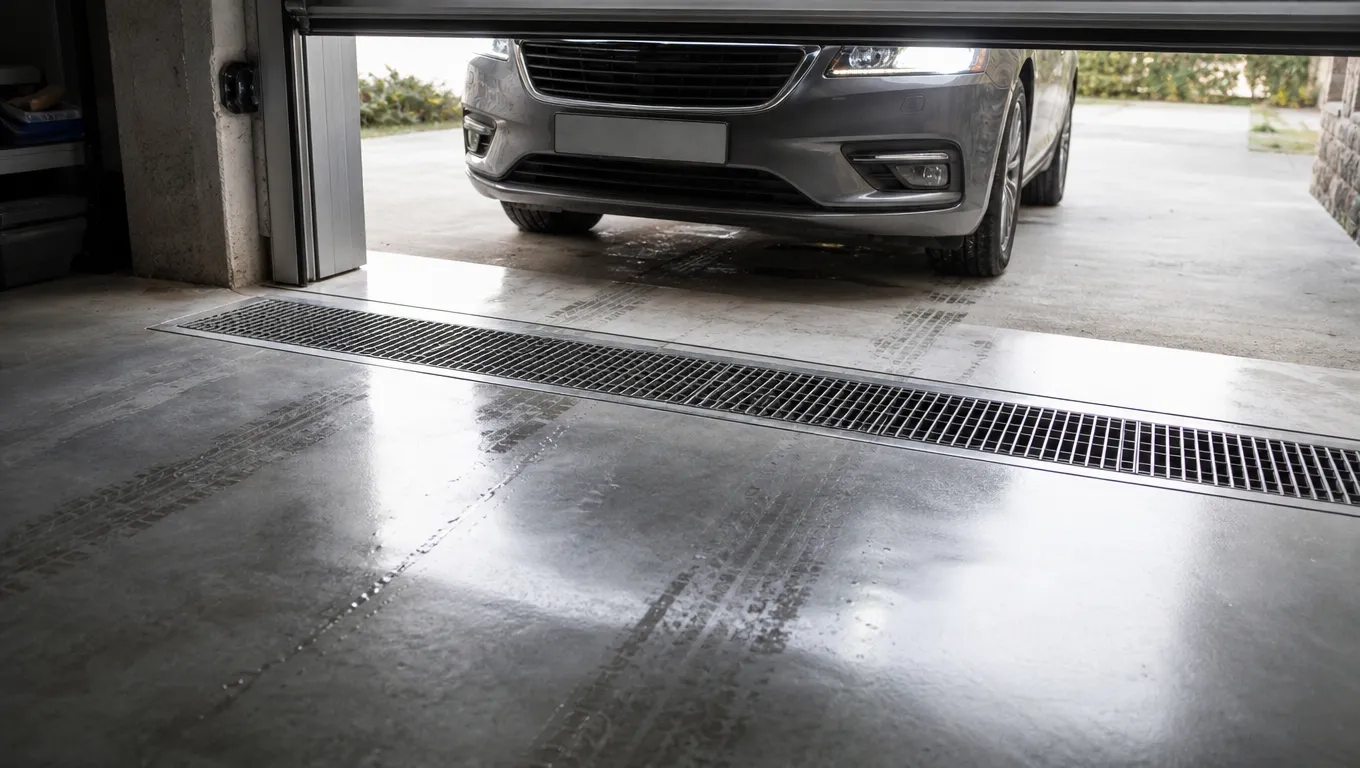
Our modular stainless trench and channel drains bolt together in 580 mm and 1160 mm sections across 150–350 mm widths (150–160 mm body depth), with 90° elbows, tees and crosses. For outdoor aprons and garage entries, see our trench & channel drain buyer's guide and channel drain for driveway guide.
3. Heavy-duty laundry and utility point drain
In finished basements, laundry rooms and mechanical closets where cars never roll, a compact stainless point drain with a 50 mm–75 mm (2–3 inch) outlet and a deep lint basket is enough. See our laundry floor wastes and anti-odor washing machine drain connectors for direct appliance tie-ins.
Slab Slope and Drain Placement
A floor drain only collects water that reaches it. Get the placement or the slab pitch wrong and water ponds under parked tires or creeps under drywall plates.
Garage placement and pitch
- Center-of-bay gully: Placed roughly centered under the parking bay (or offset slightly toward the door half where snowmelt drips off wheel wells). Requires a 4-way bowl slope from the perimeter walls toward the grate.
- Threshold channel at the overhead door: Runs just inside (or outside) the door seal line to stop wind-driven rain and driveway runoff, paired with a gentle single-direction pitch from the back wall toward the door.
- Center trench between multi-car bays: Slab pitches from both side walls into one shared central channel — simpler concrete finishing than forming two or three separate 4-way bowls.
- Target slope: Roughly 1% to 2% (about 1/8 inch to 1/4 inch per foot) toward the drain, verified against your local building code. Less than 1% leaves birdbath puddles on troweled concrete; much above 2% feels noticeably tilted under tool cabinets and rolling workbenches.
Basement placement and pitch
- Mechanical / utility zone: Set the primary floor drain near the water heater, boiler, softener and HVAC condensate line so a relief-valve discharge or tank leak runs straight into the grate rather than across finished flooring.
- Laundry area: Position a dedicated drain near the washing machine pan or standpipe drop, sloped locally at roughly 1:80 to 1:50 (1.25%–2%).
- Walkout basement doors: Use a short channel drain or an exterior area gully outside the threshold — never rely on an indoor utility drain across the room to catch outdoor storm runoff.
Code check before rough-in: Local plumbing codes govern where garage floor drains may discharge. Many jurisdictions prohibit tying a residential garage drain directly to a storm ditch, or require an oil/sand interceptor on multi-bay and commercial garages before connecting to sanitary sewer. Confirm outlet routing with the local authority before pouring the slab.
Trap Seals and Dry-Basement Odor Control
The number-one complaint on basement floor drains is sewer smell in winter. Almost every time, the drain itself is unbroken — its water seal has evaporated.
A standard P-trap under the slab (or an internal water-seal cup) holds roughly 50 mm (2 inches) of standing water. In a basement that stays dry for months while furnace air lowers indoor humidity, that water column evaporates and leaves an open pipe to the sewer. Our floor drain traps, primers and odor prevention guide covers all five failure modes in detail; for garages and basements, four practical defenses apply:
- Deeper sump reservoir: A deep-body gully holds a larger volume of water than a shallow shower waste, buying extra weeks between refills — and collects grit below the seal.
- Trap primer (plumbing-system device): Where code mandates one on commercial or seldom-used basement drains, the plumber installs a trap primer line from a nearby cold-water fixture to top up the P-trap automatically. (Trap primers are plumbing valves rather than drain hardware and are not part of our product range.)
- Drop-in odor-proof core (double protection): Seating a deodorizer core — such as a magnetic-float insert, stainless gravity flap or ABS self-sealing valve — inside the drain bore adds a physical valve that stays closed when dry and opens under water weight. Paired with an existing water seal, it acts as backup insurance when nobody remembers to pour water down the basement drain.
- Mechanical odor trap: For indoor utility drains without a water trap below, a mechanical odor trap uses a gasketed flap cartridge that lifts out from above for periodic cleaning.
Note on garage grit: Any mechanical flap or drop-in core used in a sandy garage must sit below a strainer basket, and be rinsed periodically so sand grains do not prop the seal slightly open.
Freeze Protection and De-Icing Salt in Cold Climates
Unheated detached garages, parking decks and walkout thresholds introduce two winter problems that indoor bathrooms never face: frozen traps and chloride corrosion.
Preventing frozen traps
Water expands when it freezes. In an unheated garage slab or near an overhead door, a shallow water seal sitting right below the grate can freeze solid — blocking drainage during a mid-winter thaw and cracking brittle plastic trap inserts or cast-in PVC bowls. Three ways to design around it:
- Bury the P-trap below the frost depth in the soil beneath the slab where ground warmth protects it, rather than using a shallow surface water cup right at floor level (verify trap depth limits in local plumbing code).
- Use a waterless trap insert in unheated outdoor or semi-outdoor drains (where permitted by local code): its flexible membrane seals against odor and insects with zero standing water to freeze.
- Specify stainless steel for the drain body and grate: 304 and 316 stainless keep their toughness at sub-zero temperatures, whereas thin PP/PVC grates turn brittle under cold tire impact.
Road salt and material choice: 304 vs 316 vs Cast Iron
In snow-belt regions, cars carry slush laced with sodium chloride, calcium chloride or magnesium chloride into the garage and drip it directly onto the grate all winter.
- 304 stainless steel handles normal washdown water, detergents, motor oil drips and mild climates reliably, and is our standard grade for indoor basements, workshops and temperate garages.
- 316 stainless steel adds 2–3% molybdenum specifically to resist chloride pitting corrosion. Specify 316 whenever de-icing road salt drips off vehicles in winter or the building sits within coastal salt air. See 304 vs 316 Stainless Steel Floor Drains for full chemistry and lifecycle comparison.
- Cast iron offers heavy compressive mass for industrial slabs, but unpainted rims and grates rust quickly under wet road salt and can chip when struck by steel floor jacks or dropped tools.
Grate Strength and Vehicle Traffic (Without Fake Tonnage Claims)
A garage drain grate has to survive what actually rolls over it: family SUVs turning into a bay, loaded tool chests on small hard casters, or pallet jacks in a workshop. Two engineering realities matter more than marketing numbers:
- Concrete encasement carries the load. Laboratory standards such as EN 1253 classify grates by applied test loads — which are not the same as permitted vehicle gross weight. In real floors, the frame flange transfers wheel force into the surrounding concrete encasement. A heavy grate set on weak, hollow mortar will rock and fail; a properly framed stainless grid gully or bar-grate channel vibration-compacted in concrete handles wheeled traffic cleanly.
- Opening width and plate thickness. Keep grate slots ≤ 10 mm where rolling tool-cart casters, bicycle tires or pets cross the drain. Choose welded bar/grid grating or reinforced thick-plate covers (1.5–2.0 mm+ pressed or heavy bar grid) rather than thin decorative bathroom covers (~0.8–1.2 mm), and secure vehicle-path channel grates against lifting.
We do not publish generic tonnage tables across models: send us your vehicle or cart load case at RFQ stage and we match the body, grate thickness and available test documentation model by model.
Why Is My Basement Floor Drain Backing Up?
Searches for a floor drain backing up in a basement spike after heavy rain or laundry cycles. Because the basement floor drain is the lowest fixture opening on the building's drainage tree, water rising out of it is a symptom of downstream blockage or surcharge — not a broken grate:
- Main building sewer restriction (tree roots, grease, bellied pipe): If flushing an upstairs toilet or draining a bathtub makes water rise at the basement floor drain, the blockage is downstream in the building main. Stop running fixtures and have the main line camera-inspected and cleared via the cleanout — do not rod aggressively through a small trap insert without removing internal parts first.
- Local branch clog (lint and sediment): If only the nearby laundry sink or washing machine causes backup, lint or grit has packed the branch trap or horizontal run. Lift out the strainer basket and removable water seal (on serviceable gullies) to clear the sump first before snaking downstream.
- Municipal sanitary or combined-sewer surcharge during storms: During extreme rain, street sewers can pressurize above basement slab elevation and push water backward up the lowest floor drain. Important: a lightweight odor-proof core or odor flap is built to stop low-pressure sewer gas, not pressurized sewage backflow. True flood protection requires a code-approved backwater valve installed on the underground branch or building drain by a licensed plumber, or a separate sump-pump pit for foundation groundwater.
Never plug a backing-up basement drain permanently with a solid rubber test plug unless you want sewage to rise into the next lowest fixture (such as a basement shower or utility sink) or lift the slab under hydrostatic pressure.
Quick Specification Checklist for Builders and Buyers
Before ordering garage or basement drains, confirm these six specs:
- Application & traffic: Basement foot traffic only, residential car bay, or workshop pallet trucks / service vehicles.
- Drain geometry: Point gully (4-way floor fall) vs modular channel run (1-way slab pitch; specify run length in 580 / 1160 mm modules and 150–350 mm width).
- Outlet diameter & orientation: Match underground pipe (typically 50 / 75 / 100–110 mm, i.e., 2" / 3" / 4"; vertical bottom vs horizontal side outlet when slab depth is tight).
- Steel grade: 304 stainless for dry/temperate basements and utility rooms; 316 stainless where winter road salt or coastal chlorides are present.
- Trap & odor strategy: Deep removable water seal + optional drop-in deodorizer core for dry basements, or waterless insert where standing water would freeze.
- Debris & cleanout access: Lift-out stainless strainer basket sized for sand/gravel (garage) or lint (laundry/basement), plus spare sealing rings/baskets for multi-unit jobs.
Melody Drain
We manufacture stainless steel drainage hardware for residential, commercial and industrial slabs — including five-part serviceable industrial floor gullies, modular trench and channel drains (with custom lengths, outlets and 304/316 grades), laundry and utility floor wastes, and retrofit smart anti-odor traps and cores. Send us your slab layout, pipe size, climate/salt exposure and traffic case, and our engineering team will recommend the matching configuration and quote factory-direct. Contact us or message us on WhatsApp.